How Do You Know How Many Cubic Yards of Pressure Treated Wood
Pressure-Treated Lumber Weight • Complete Nautical chart
Roof Online Staff
Curl down to see the chart.
See More Roofing Topics
Tabular array of Contents
- How Much Does Pressure-Treated Lumber Weigh?
- Nearly this Force per unit area-Treated Lumber Weight Table
- Table of Pressure-Treated Lumber Weights
- Type of Woods Used for Pressure-Treating
- Forest Force per unit area-Treatment Process
- Weight of Water in Pressure-Treated Lumber
- Weight of Preservative in Force per unit area-Treated Lumber
- Ask the Lumber Company!
- Related Pages
How Much Does Force per unit area-Treated Lumber Weigh?
The weight of force per unit area-treated lumber depends on how much time has gone past since the wood was treated, equally well as the size of the board or mail service.
Most force per unit area-treated lumber is made from southern yellow pine, which is a relatively heavy forest to begin with, then pressure-treated wooddoes tend to exist heavier than most other lumber because of this lonely.
But the weight that people really notice when it comes to treated lumber is the water weight that the woods picks up while beingness treated.
A x-pes-long 2×6 pressure treated lumber lath weighs around 40 pounds right after existence treated. The same board merely weighs effectually 23 pounds later on it has had time to dry.
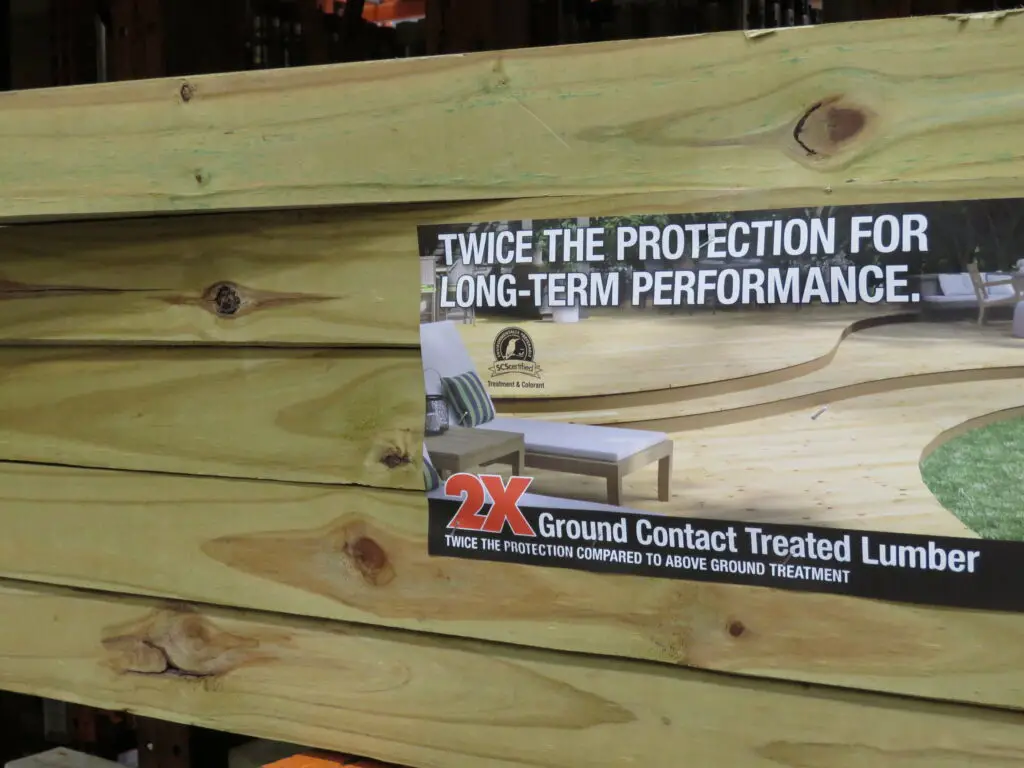
About this Pressure-Treated Lumber Weight Table
The post-obit table provides the heaviest approximate weight (dead load, self-weight) per linear foot of pressure-treated lumber.
The weights are for the wood immediately after being treated, for the wood after information technology has dried thoroughly, and for untreated wood with the same dimensions.
This table is intended to give you lot an idea as to what pressure-treated forest might weigh at its heaviest.
The values given are for the heaviest wood species, longleaf pine (southern yellow pine, longleaf), normally used to produce pressure-treated lumber.
The "freshly treated" cavalcade in the chart shows the weight for the wood when it contains the highest amount of h2o commonly added to the wood during treatment (shut to four gallons, or about 32 lbs., per cubic foot).
Table of Pressure-Treated Lumber Weights
For an explanation of the difference betweennominal lumber dimensions andactualdimensions, see our Lumber Dimensions Table.
| Weight of Pressure level-Treated Lumber | ||||
|---|---|---|---|---|
| (Southern Yellow Pino, Longleaf) | ||||
| Nominal Dimensions of Lumber in Inches | Actual Dimensions of Lumber in Inches | Untreated Lumber Weight (Air Dried Lumber) | Freshly Treated Lumber Weight (Maximum Weight) | Treated Lumber Weight After Drying |
| Cubic Pes | 12 x 12 10 12 | 41 pounds per Cubic Foot | 73 pounds per Cubic Foot | 41.6 pounds per Cubic Foot |
| Board Foot | 12 x 12 10 1 | 3.42 pounds per Board Human foot | 6.08 pounds per Board Foot | 3.47 pounds per Lath Foot |
| Per Linear Pes: | Per Linear Foot: | Per Linear Foot: | ||
| i x 2 | 0.75 inch x 1.5 inch | 0.32 lbs | 0.57 lbs | 0.32 lbs |
| 1 x 3 | 0.75 x ii.five | 0.53 | 0.94 | 0.54 |
| 1 10 4 | 0.75 x iii.five | 0.75 | 1.34 | 0.76 |
| 1 x 6 | 0.75 x v.5 | 1.17 | two.08 | i.18 |
| 1 x 8 | 0.75 x 7.25 | one.61 | ii.87 | one.63 |
| 1 x 10 | 0.75 ten 9.25 | 1.98 | 3.52 | ii.00 |
| 1 x 12 | 0.75 ten eleven.25 | 2.forty | iv.27 | 2.42 |
| 5/4 x half dozen | 1 x 5.v | 1.57 | 2.79 | 1.59 |
| 5/4 ten 8 | i x 7.25 | 2.06 | 3.67 | two.09 |
| two x three | 1.5 x 2.5 | one.07 | 1.90 | 1.08 |
| 2 x iv | one.5 inch x 3.5 inch | 1.49 lbs | 2.65 lbs | one.5 lbs |
| 2 ten 6 | 1.five 10 5.5 | ii.34 | 4.17 | 2.36 |
| 2 x 8 | i.5 x vii.25 | 3.09 | five.fifty | 3.12 |
| 2 x 10 | 1.five x 9.25 | 3.95 | 7.03 | iii.99 |
| 2 x 12 | ane.five ten 11.25 | 4.eighty | eight.54 | 4.85 |
| 2 ten 14 | 1.5 x 13.25 | five.65 | 10.06 | v.71 |
| 2 x 16 | 1.5 x 15.25 | six.52 | eleven.61 | 6.58 |
| iii ten four | 2.5 10 3.v | ii.49 | 4.43 | 2.51 |
| iii x six | 2.5 x 5.5 | 3.91 | vi.96 | 3.95 |
| 3 x 8 | 2.five x 7.25 | v.15 | nine.17 | 5.20 |
| 3 x 10 | 2.five inch x 9.25 inch | six.59 lbs | 11.73 lbs | 6.65 lbs |
| 3 ten 12 | ii.5 x 11.25 | 8.01 | 14.26 | 8.09 |
| iii x 14 | 2.5 ten 13.25 | 9.43 | 16.79 | nine.52 |
| 3 x xvi | 2.v ten fifteen.25 | 10.85 | 19.31 | 10.96 |
| four x 4 | iii.5 x 3.5 | three.49 | 6.21 | three.52 |
| 4 x vi | 3.v x 5.five | five.48 | 9.75 | 5.53 |
| iv 10 8 | 3.v x 7.25 | 7.22 | 12.85 | 7.29 |
| iv x 10 | 3.5 x nine.25 | 9.23 | 16.43 | 9.32 |
| 4 x 12 | 3.5 x 11.25 | 11.22 | 19.97 | 11.33 |
| 4 ten 14 | 3.5 ten xiii.25 | 13.21 | 23.51 | 13.34 |
| 4 x 16 | 3.5 inch x xv.25 inch | 15.2 lbs | 27.06 lbs | 15.35 lbs |
| six ten 6 | 5.5 x five.5 | 8.61 | xv.33 | viii.69 |
| 6 ten 8 | v.5 x seven.25 | xi.35 | twenty.20 | 11.46 |
| vi ten 10 | five.5 x ix.25 | 14.48 | 25.77 | 14.62 |
| 6 ten 12 | 5.v x xi.25 | 17.62 | 31.36 | 17.79 |
| 6 x 14 | five.5 x 13.25 | 20.75 | 36.94 | 20.95 |
| vi x 16 | 5.5 x 15 | 23.49 | 41.81 | 23.72 |
| 8 ten 8 | 7.25 x 7.25 | 14.97 | 26.65 | 15.12 |
| 8 10 10 | 7.25 x 9.25 | nineteen.09 | 33.98 | 19.28 |
| viii x 12 | 7.25 10 11.25 | 23.22 | 41.33 | 23.45 |
| 8 ten 14 | 7.25 inch x thirteen.25 inch | 27.35 lbs | 48.68 lbs | 27.62 lbs |
| viii x sixteen | 7.25 x 15 | 30.97 | 55.xiii | 31.27 |
| 8 x 18 | 7.25 10 17 | 35.10 | 62.48 | 35.44 |
| ten x x | ix.25 ten 9.25 | 24.37 | 43.38 | 24.61 |
| 10 x 12 | ix.25 x 11.25 | 29.62 | 52.72 | 29.91 |
| x x fourteen | 9.25 x 13.25 | 34.89 | 62.ten | 35.23 |
| 10 10 xvi | nine.25 x 15 | 39.51 | 70.33 | 39.90 |
| 10 x xviii | 9.25 10 17 | 44.78 | 79.71 | 45.22 |
| 12 x 12 | 11.25 ten 11.25 | 36.04 | 64.fifteen | 36.39 |
| 12 ten 14 | eleven.25 x 13.25 | 42.44 | 75.54 | 42.86 |
| 12 x 16 | 11.25 inch ten 15 inch | 48.04 lbs | 85.51 lbs | 48.51 lbs |
Blazon of Forest Used for Pressure-Treating
Around 85% of the force per unit area-treated forest in the The states is made from southern yellow pine.
There are a few different sub-species of southern xanthous pine, with unlike wood densities. We used the longleaf multifariousness to summate the values shown in the nautical chart.
Meet Weight of Dimensional Lumber for the weights of other woods species commonly used for lumber.
A much more than extensive list of wood densities, which includes the other varieties of southern xanthous pino, tin be plant in "Weights of Various Forest Grown in the The states".
Wood Pressure-Treatment Process
Force per unit area-treated lumber is produced by usingloftier force per unit area to force a solution of water and chemic preservatives deep into the woods.
Stacks of lumber are placed in a big steel cylinder in a bath of water and preservative. This tank is pressurized until the wood becomes saturated.
After the wood dries out, the preservative remains throughout the wood, protecting it from decay for years.
Weight of Water in Pressure-Treated Lumber
The noticeable extra weight of pressure-treated lumber is due to the water added during the treatment procedure.
Typically, close to four gallons of water (almost 32 pounds) of water is added to each cubic foot of pressure-treated wood. This means that the wood weighs over 75% more than when it comes out of the tank than when it goes in.
As the wood returns to its normal air dried weight over the following weeks or months, it also returns (nearly) to its pre-treated weight.
Weight of Preservative in Pressure level-Treated Lumber
In one case it dries, the weight difference betwixt pressure level-treated lumber and untreated lumber is entirely due to the weight of the preservative retained in the woods. This weight is minimal.
The maximum additional weight due to preservative is effectually 1.v% for "footing contact" designated lumber using CCA (chromated copper arsenate) or ACQ (alkaline copper quaternary) as a preservative.
For much of the pressure-treated lumber bachelor today for residential apply, the additional weight will be less. "Ground contact" lumber treated with the widely-used CA-C (copper azole, type C), for instance, will only weigh nigh 0.37% more than untreated wood.
Enquire the Lumber Company!
The values given in the table are meant to provide a general idea of typical pressure-treated lumber weights, and should not be used if precise values are needed for disquisitional engineering calculations.
When precision is necessary, always refer to the specification sheet for the actual, specific product you intend to utilize, or contact the technical department of the lumber producer.
Run acrosspressure-treated lumber at the Dwelling Depot. The gauge weights of the actual pieces of pressure-treated lumber for sale are usually given in the production descriptions, so this can be a skilful resources for computing these weights. Domicile Depot also delivers to your dwelling house, past the style.
- American Softwood Lumber Standard
- Weight of Dimensional Lumber
- Weight of Plywood and OSB
- Weight of Roofing Materials
- Weights of Diverse Woods Grown in the United states of america
Source: https://roofonline.com/weights-measures/weight-of-pressure-treated-lumber/
0 Response to "How Do You Know How Many Cubic Yards of Pressure Treated Wood"
Post a Comment