What Were the Painting Characteristic of Germann Art Painters in the 1920s
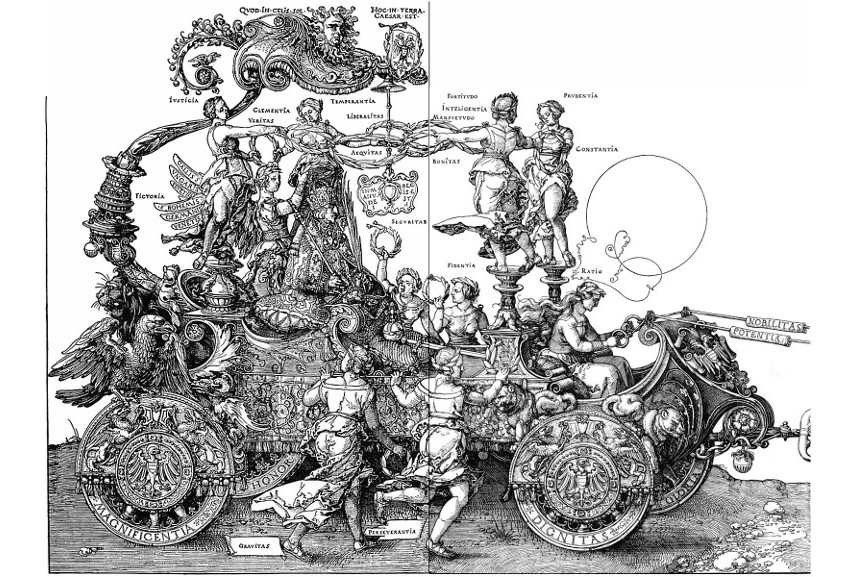
German art history is one of the finest examples of merely how different 1 country'south scene tin exist when compared to their neighboring nations. Although its artistic heritage is sometimes not appreciated enough in comparison to the next countries, and because of the two World Wars which stagnated its 20th-century art, Germany nevertheless remained a state that had its own say in most European movements and periods. Historically speaking, the definite highlight of German fine art history is the architectural heritage with its immense value to archaeologists, historians and art lovers alike. German language builders and architects were renowned throughout the Quondam Continent and were highly sought afterward. The finest examples of Romanesque and Gothic compages can be found in Frg, whilst some of the most impressive Bizarre and Rococo churches and palaces also call this state their home. Of course, in that location were High german artists who contributed to other mediums, such every bit the famed Albrecht Dürer [1], but the marvels of lightness and spatial complexity of Germany's architectural achievements are truly unparalleled. Regardless of what medium or style German painters, sculptors and architects were creating in, they were always seeking to institute a national approach to every piece. Their Gothic buildings are unique in both ornament and technique segments, Renaissance works[ii] are radically different than the artwork of their Italian contemporaries, Baroque gems differ from French pieces, etc. It is that separatistic characteristic that makes German language art history such an exciting topic to discuss.
This constant variation was due to the strong sense of German identity, an thought that their own heritage is something to exist proud of and that information technology must non be compromised past outsider's influences. These kinds of ideas are deeply rooted in the visual arts of Federal republic of germany, especially since the time of the 18th century and the conflicts with nearby countries. Always since then, many felt that High german states were in danger of losing their own identity. Therefore, artists had the duty of preserving their ain fine art without allowing elements of other scenes - especially French elements- to set their roots in Germany. Such concepts culminated in many popular theories such as the 18th-century idea that Germans were the closest relatives of Ancient Greeks and Romans. Of course, the most prominent of these theories found their way into the core of every art movement Germany went through in the last few centuries. This shall be elaborated in the remainder of this text as we go through the almost notable moments of German art history.
Neoclassicism
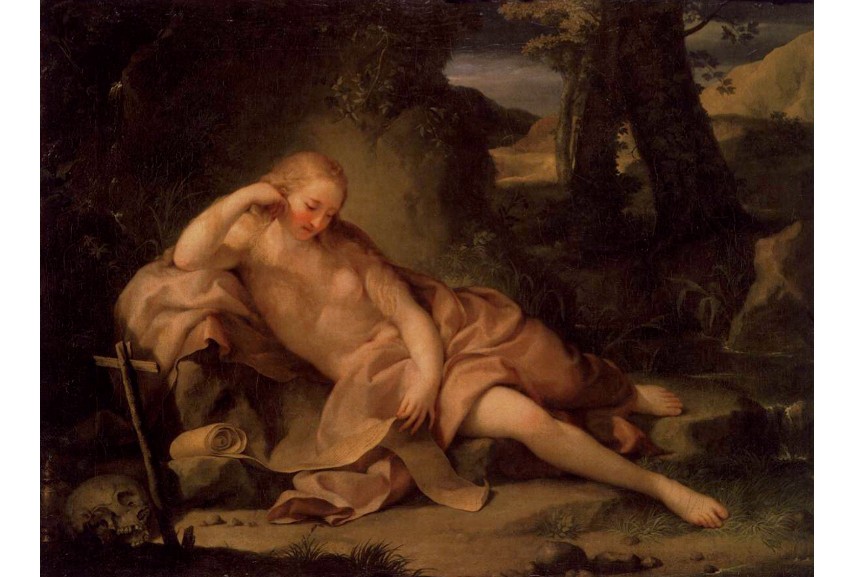
The decades which served every bit the Neoclassicism affiliate of German art were quite dynamic, to say the least. This famed art move appeared rather earlier in Germany than in France, which is a flake ironic as French Neoclassicism is often used as the primary example of this period. There were three artists who marked this part of German language art history - a sculptor Gottfried Schadow (1764–1850) and two painters, Anton Raphael Mengs (1728–79) and Asmus Jacob Carstens (1754–98). Mengs was the accented star of the iii equally he established the vocabulary of an early Neo-Classical style in Germany. On the other paw, Carstens' shorter career was turbulent and troubled, marked with many unfinished pieces. The core idea of German Neoclassicism was not that dissimilar from its French analogue - artists and theorists desired to revive art and render it to the greatness of ancient Greece and Rome. In other words, representatives of this movement were hoping for another Renaissance-like moment. Neoclassicism can also exist very precisely defined every bit a reaction to the emotionally strained Baroque.
Just as the instance was with French Neoclassicism, the German accept on the movement was conceptually continued with the idea of Enlightenment. This led to an increase of educated individuals and many new academies were starting to appear around Germany. This was likewise the fourth dimension that Johann Joachim Winckelmann, a High german man that quite literally initiated the study of arthistory and archeology every bit nosotros see them today, was establishing his career. The pieces he wrote in the later periods of his life will prove to exist the pivotal books of the discipline, effectively making Winckelmann the father of the 2 disciplines. And he was not the only author worth mentioning from this period - the Enlightenment period saw German writers becoming leading theorists and critics of fine art, all led by Winckelmann who praised Ancient Greek art. Hearing his ideas, German artists of Neoclassicism gathered around the ideas of a free human and ancient heritage, which was heavily reflected in the visuals of their artworks. Inspired by Winckelmann's success, Goethe and Friedrich Schiller also started exploring similar topics. Therefore, the Neoclassicism menstruation of German art history is more connected to the written word than to the visual arts. This is what distinguishes it from Neoclassicism of other countries.
Romanticism and the Nazarenes
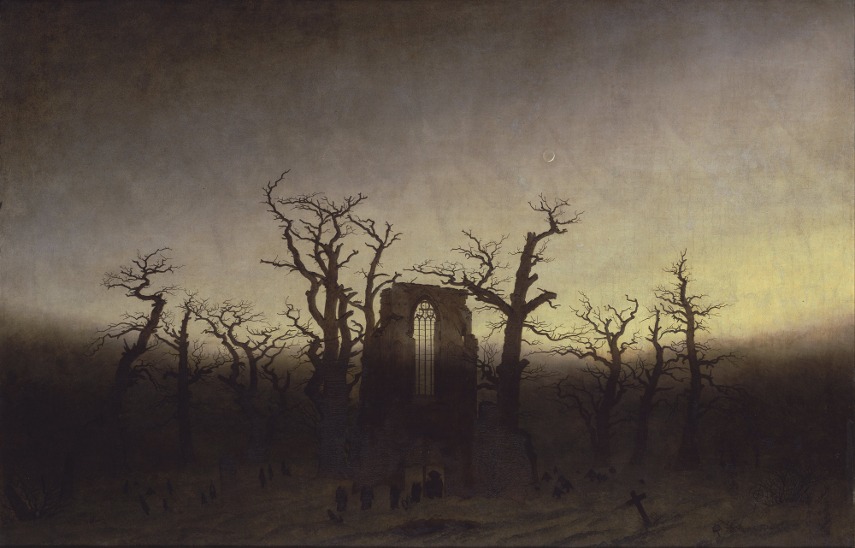
Different the times of German Neoclassicism, the next menses of this country's fine art was a lot more than innovative and distinctive from other European countries. Romanticism gave nativity to a number of artists with very individual styles. The most notable and influential artist of German Romanticism was the legendary Caspar David Friedrich, one of the greatest painters to have ever lived. He mostly painted landscapes[3] underlined by a strong Northern character and a feeling of religious stillness. This creative person would ofttimes innovate homo subjects to his compositions just they are always lost in contemplation of the landscape. The romantic and enchanting paintings Caspar David Friedrich fabricated in his time are some of the greatest and virtually beautiful pieces of German fine art. Unfortunately, Caspar David Friedrich was misunderstood for the bulk of his life, just this visionary from Germany's neat Romantic period tin today be mentioned in the aforementioned jiff as the likes of William Turner and John Lawman.
Some other motion of German art history tin be linked to Romanticism. With a name that originally came from a mocking critic, the Nazarene movement was put in motion by early 19th-century High german Romantic painters who aimed to revive honesty and spirituality in Christian art. The primary motivation of the Nazarenes was to oppose Neoclassicism and the routine fine art educational activity of the academic system which they saw every bit wrong[four]. These artists hoped to return art on a course that leads to spiritual Christian values and because of that, they sought inspiration from the late Middle Ages and early on Renaissance. Due to such concepts, the Nazarenes have ofttimes been connected to the mid 19th century English Pre-Raphaelite Brotherhood, a group who had rather similar goals. The main artists of the Nazarene movement were Johann Friedrich Overbeck, Franz Pforr, Ludwig Vogel and the Swiss Johann Konrad Hottinger. These members developed virtually of their ideas in Rome, where they occupied the abandoned monastery of San Isidoro.
Biedermeier and Secession
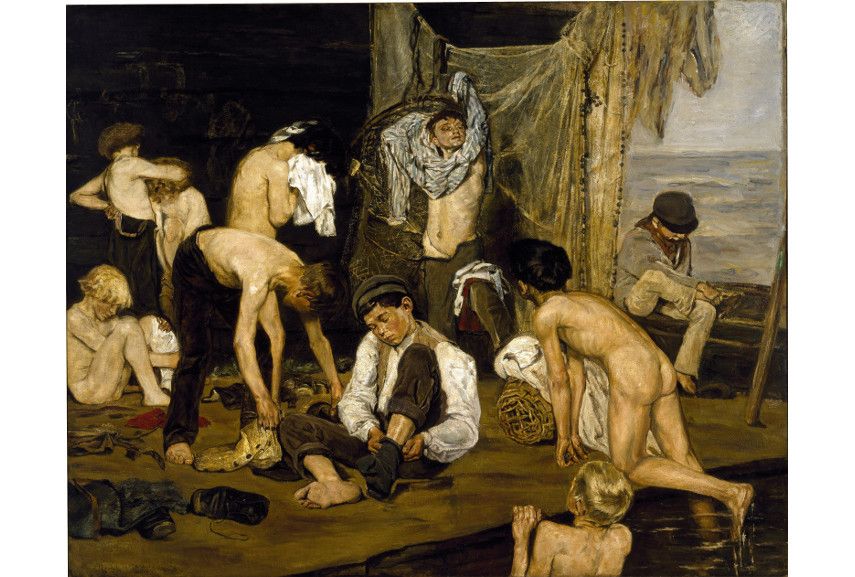
The term Biedermeier refers to a fashion of literature, music, the visual arts and interior design in the period betwixt the stop of the Napoleonic Wars in 1815 and the overwhelming revolutions of 1848. The fine art of this period appealed to the prosperous centre classes by detailed but polished realism, often jubilant domestic German virtues. An creative person Carl Spitzweg was a leading German language effigy of the Biedermeier style[v]. It should exist noted that this movement was of international grapheme and other European countries had its ain takes on Biedermeier. The second one-half of the 19th century Germany did not accept a particular movement or way, but it was marked by an fifty-fifty stronger tendency to highlight the nation's proud identity. The Berlin Secession group is the final notable moment in the 19th-century German language art - an association founded in 1898 by painters Max Liebermann and Lovis Corinth. This is one of the nearly influential groups from the end of the century, which is rather interesting as the Berlin Secession did not impose a particular style and was rather lax in that department.
German Art History of the 20th Century
Investigating the 20th-century German art is an intriguing topic. The reason for this is because during the years between 1900 and 1945 Germany went through two Globe Wars[vi], a long listing of technological and cultural changes, and had so many different protest fine art movements that sometimes information technology is difficult to tell them all autonomously. Furthermore, many of the artists were in multiple groups over the years, sometimes changing their artistic styles along the way. This state of affairs meant that German art of the 20th century was adult through a number of loose groups and movements, underlined by the nation'south most shameful menses of which many German artists were well aware of. After both Globe Wars concluded, Federal republic of germany went into a turmoil on all fronts including the culture one but was still able to brand an impact on contemporary art. Unfortunately, we are stripped from the knowledge just how much this nation'south artists would exist able to change the course of art if Germany did not cause the most devastating and horrifying events the globe has ever seen.
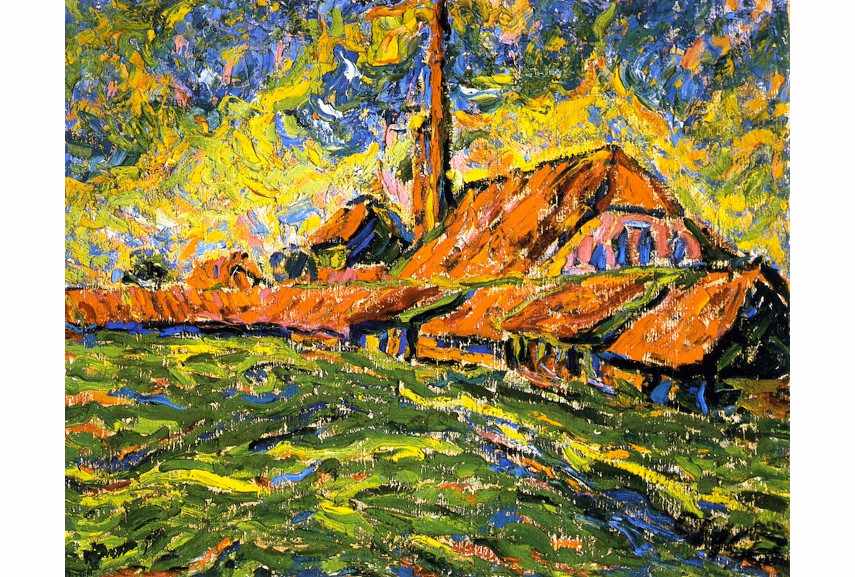
Die Brücke (The Bridge) and Der Blaue Reiter (The Blue Passenger)
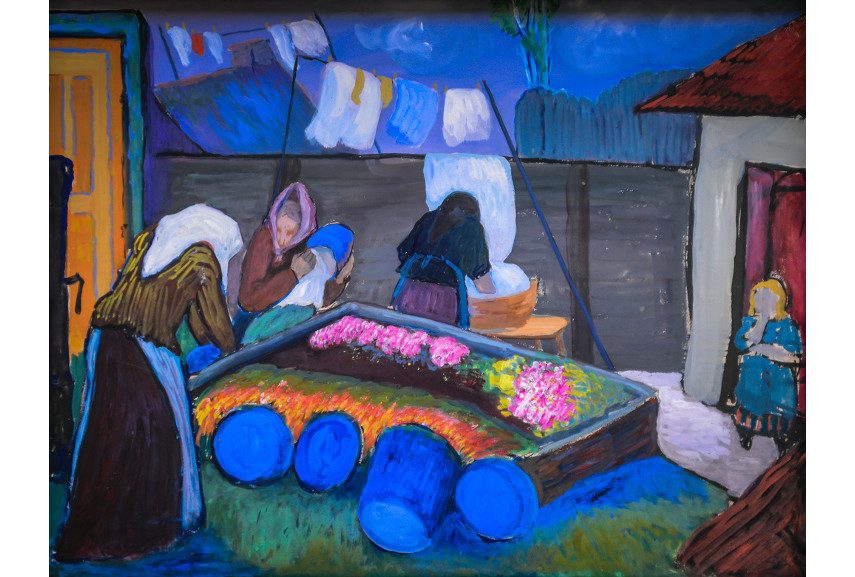
The Bridge and The Blue Rider were ii groups of German painters fundamental to the development of Expressionism, one of the key movements of early avant-garde [7]. Die Brücke was a group of German language expressionist artists formed in Dresden in the twelvemonth of 1905 by architecture students who wanted to be painters. These were Fritz Bleyl (1880–1966), Erich Heckel (1883–1970), Ernst Ludwig Kirchner (1880–1938) and Karl Schmidt-Rottluff (1884–1976). Although Dice Brücke broke upwardly in 1913, the group did manage to rediscover woodcut as a valid medium and lay the grounds for many abstract concepts of art. Der Blaue Reiter was formed in Munich in 1911. The grouping's forming is closely tied to its well-nigh important member, who was, in fact, a Russian painter. This is Wassily Kandinsky and it was later his painting Last Judgment was rejected by a prestigious Berlin gallery that The Blue Rider came to be. Franz Marc, August Macke, Alexej von Jawlensky and Marianne von Werefkin were other members of the group. Their entire output was based on Wassily Kandinsky's ideas on expression and devoutness channeled towards an honest, direct and spiritually engaged artwork.
Dada and Bauhaus
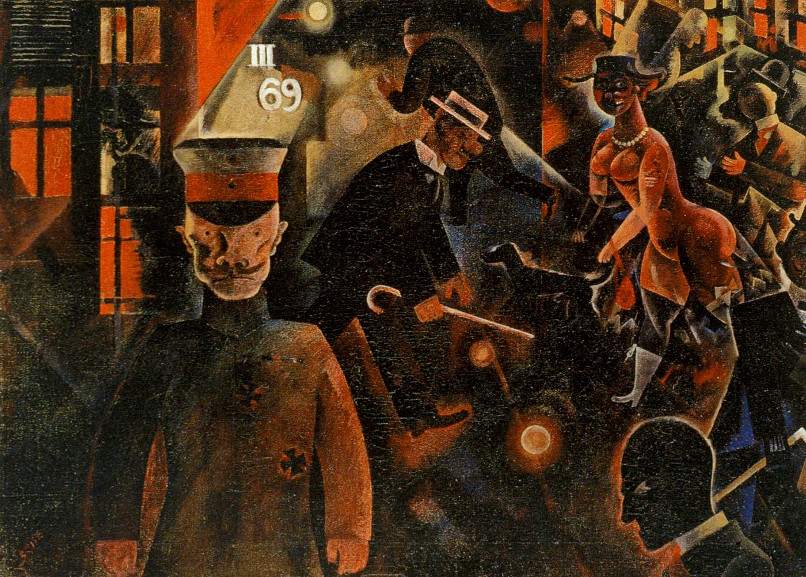
Another major feature of German fine art emerging from the early 20th century was a strong tendency towards producing works of a grotesque style[8]. Artists like George Grosz, Otto Dix and Max Beckmann are all skilful examples of how grotesque expression shaped a person's portfolio. Dadaistic concepts had a great role to play equally far as German grotesque manner is concerned. Interestingly, Dada in Germany was a lot more political than the instance was in other countries. Kurt Schwitters and Hannah Höch are the leading practitioners of Germany's Dadaistic expression. Schwitters is also important for his Merzbau, a precursor of installation art. Max Ernst worked in Dada style too, simply because of his transition into Surrealism, we can non call him the leading representative of German Dada.
There was some other important moment in German fine art history before the Nazi government was established and that is the now legendary Bauhaus schoolhouse. This was the virtually influential modernist fine art school of the 20th century and the approach to teaching and agreement art's relationship to gild was quite revolutionary. Bauhaus' goal was to level the stardom between fine and applied arts, reuniting creativity and manufacturing. Besides the founder of Bauhaus, Walter Gropius, at that place were other greats from German art associated with this institution - such as Ludwig Mies van der Rohe, Josef Albers, Laszlo Moholy-Nagy, Paul Klee, Johannes Itten and Marcel Breuer.
Be sure to check out works by Josef Albers on our marketplace!
Art in the Tertiary Reich
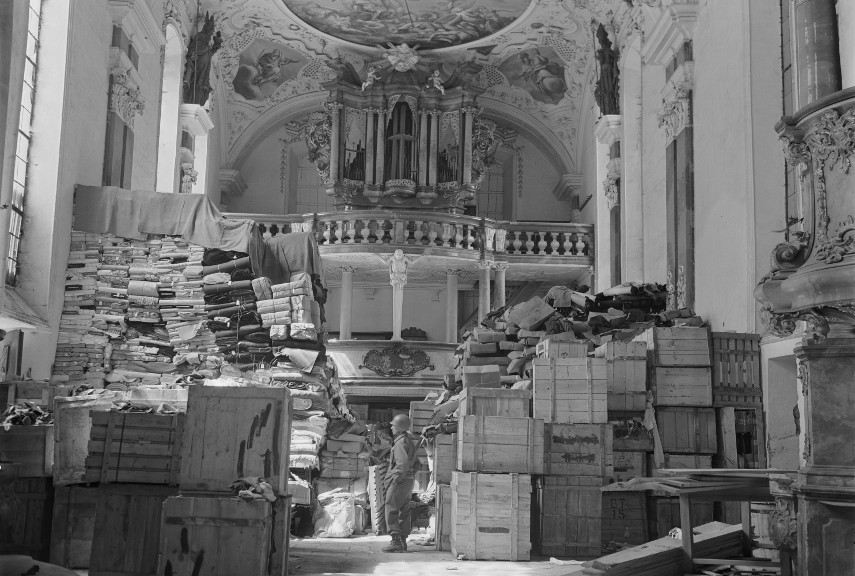
Although the most notorious by far, the fine art in the 3rd Reich may very well be the nearly interesting period of German fine art history to study. The rigorous Nazi regime banned mod art, explaining such a decision past stating that such art is highly degenerated. Every bit far equally the Nazi ideology was concerned, this art deviated a bit too far from the prescribed norm of classical beauty. The menstruum between the 1920s and Hitler's ascension to complete power over Federal republic of germany was marked past a mutual disagreement with avant-garde artists, but it never went also far from harsh words. Even so, when Hitler made sure the three main political roles of Frg were his, all the avant-garde artists were branded equally both enemies of the state and a threat to the German nation's identity[9]. What followed is an all too well-known scenario to Nazi Germany, every bit only some were lucky enough to leave the land on time. In club to prove the devastating effect of modern art, Nazis mounted a polemical exhibition entitled Entartete Kunst (Degenerate art) in Munich, during July of 1937. This prove was intended to exist an official condemnation of modern art. It included over 650 paintings, sculptures, prints and books from the collections of thirty-2 unlike German museums.
Mail service-WWII Chapter of German Art History
All the German art trends afterwards the horrors of Earth War II can broadly be divided into Neo-expressionism and Conceptualism. The starting time group included the likes of Georg Baselitz, Anselm Kiefer, Jörg Immendorff, Markus Lüpertz, Peter Robert Keil and Rainer Fetting. The 2nd group had its own notable representative as well every bit the leading High german conceptual artists included Bernd and Hilla Becher, Hanne Darboven, Hans-Peter Feldmann, Hans Haacke and Charlotte Posenenske. There were many individuals who desired to work within traditional borders, such every bit Martin Kippenberger, Gerhard Richter, Sigmar Polke and Neo Rauch. However, they were nowhere almost making an impact on German art as much every bit artists of Neo-expressionism and Conceptualism. Performance art was also a huge innovation to Germany and its scene - Joseph Beuys was perhaps the about influential German artist of the mail service-Earth War Two era. This performance creative person, sculptor and theorist had many contributions to High german culture, with his famous argument that Anybody is an artist and the idea behind information technology being the biggest game-changer of the fourth dimension.


The essays in German Essays on Art: Winckelmann, Burckhardt, Panofsky, and others are chosen to introduce the reader to some of the writers who initiated and shaped the study of art in the German-speaking countries. Among the essayists are Johann Joachim Winckelmann, Johann Wolfgang von Goethe, Jacob Burckhardt, Franz Wickhoff and Erwin Panofsky. This drove of major works presents us with an overview of German literature and thought from medieval to present times. The readers are able to see the poetic and intellectual achievements of German art history and just how influential information technology'due south written word was to the evolution of European expression. Ultimately, German Essays on Art: Winckelmann, Burckhardt, Panofsky, and others offers a fantastic overlook and perspective on Germany's contribution to the world at heritage.
References:
- Bartrum, G., Albrecht Dürer and his legacy: the graphic work of a Renaissance creative person, British Museum Press, 2002
- Bartrum, G., German Renaissance Prints, 1490–1550, British Museum Printing, 1995
- Sir Kenneth, C., Mural into Art, Penguin , 1961
- Gombrich, E.H., The Story of Fine art, Phaidon, 1982
- Griffiths, A., High german art history in the Age of Goethe, British Museum Press, 1994
- Snyder, J., Northern Neo-Renaissance Art, Harry N. Abrams, 1985
- Jacobus, J., Modernistic German Art: Painting, Sculpture, Architecture, Prentice Hall and Harry N. Abrams, 2000
- Award, H., A Globe of Art, ISBN, 1982
- Hamilton, Thousand., mod Painting and Sculpture in Europe, Yale Academy Printing, 1983
Featured images: Caspar David Friedrich - Untitled Landscape - Image via pinterest.com; Albrecht Dürer - Saint Anthony - Image via wikiart.org; Anton Raphael Mengs - Judgement of Paris - Paradigm via oceanbridge.com; A Bauhaus Poster - Epitome via bp.com; Joseph Beuys - I Like America and America Likes Me, 1974 - Image via pinterest.com
Source: https://www.widewalls.ch/magazine/german-art-history
0 Response to "What Were the Painting Characteristic of Germann Art Painters in the 1920s"
Post a Comment