The Use of Antibiotics and the Injection of Steroids in Beef
en Español
El inglés es el idioma de control de esta página. En la medida en que haya algún conflicto entre la traducción al inglés y la traducción, el inglés prevalece.
Al hacer clic en el enlace de traducción se activa un servicio de traducción gratuito para convertir la página al español. Al igual que con cualquier traducción por Internet, la conversión no es sensible al contexto y puede que no traduzca el texto en su significado original. NC Land Extension no garantiza la exactitud del texto traducido. Por favor, tenga en cuenta que algunas aplicaciones y/o servicios pueden no funcionar como se espera cuando se traducen.
English is the controlling language of this page. To the extent there is any conflict between the English language text and the translation, English controls.
Clicking on the translation link activates a free translation service to catechumen the folio to Spanish. As with any Internet translation, the conversion is not context-sensitive and may non translate the text to its original meaning. NC Country Extension does not guarantee the accuracy of the translated text. Please annotation that some applications and/or services may not function as expected when translated.
Plummet ▲
Hormones and antibiotics in our meat products is a hot topic right now, and it's important to know facts from fiction. This article is going to briefly explain some important things near hormones and antibiotics in fauna production that I hope will shed some light on whatsoever confusion the public may have.
Let's first with hormones in chickens. At the grocery store, there are two chicken packages on the shelf with 3 chicken breasts in each package. Glancing at both packages there does not seem to be a noticeable deviation. The breast sizes are the same, colour, texture; all look the same. But the prices are much dissimilar. Labeling at the grocery store may create confusion regarding the utilize of hormones in meat production. In fact, it is illegal to give chickens hormones at all! Chickens that are bred and raised for consumption are called broilers. Through many years of selective breeding, we were able to breed chickens that grow fast with little physical activity. Broilers like to consume and sit around, and with trivial physical activity they grow quickly and are off to market within four-seven weeks.
Cattle are given hormones, but for reasons that may non be clear to the public. Start and foremost, the hormones that are given are naturally accruing hormones already found in the cow's trunk. Cattle are given hormones through a very small pellet, a piddling larger than a grain of rice, injected under the skin on the backside of the ear. When a balderdash dogie is castrated he loses some of his naturally accruing hormones and will then lack in operation. He starts to proceeds more fat than musculus, which is non what the consumer market wants. The most mutual hormone that is given is estrogen which is a natural hormone already found in the steer. Not only do the hormones go on the steer performing as it should but it besides helps requite the beefiness season that we have all become accustomed to. Without the hormones, the meat would taste a little gamier and then what the consumers are used to. Many people think that hormones are used for size, but like chickens, subsequently many years of selective breeding, we were able to breed cattle that are big framed and have great musculus structure. It is important to know that when a steer is implanted with the hormones, and it comes time to be shipped off to market the implant has been absorbed and metabolized, and no longer nowadays in the meat. Implants are tiresome arresting. It is also extremely important to know that the FDA (U.Southward. Food and Drug Administration) approves and regulates the employ of all growth-promoting implants. Cattle are not the but place that hormones take been used. Information technology was used in swine but there was no testify to prove that the hormones really helped or improved the product. Knowing this, we tin see that hormones are not only given to animals. In that location needs to be a need and benefit from using hormones.
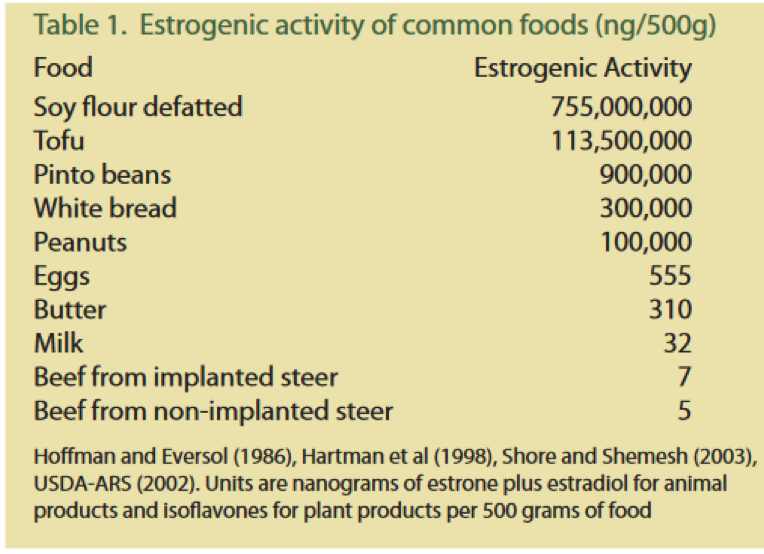
The chart beneath shows the amount of the hormone Estrogen in other foods that we consume. It also shows the amount of Estrogen in a steer that has been given hormones and a steer that has not been given hormones.
Antibiotics are given to assist keep animals healthy. Merely like when a person falls ill, they get to the doctor to get medicine to fight off whatever is ailing them. Antibiotics are given non only for the wellness of the fauna but the quality of the meat as well. If an animal is sick it cannot perform, or gain weight as it should and therefore the meat quality goes down. When antibiotics are administered to an animal information technology an antibiotic that is generally not administered to humans. There are very strict rules about withdrawal times following the administration of an antibody earlier the animal can exist processed. The USDA Food Prophylactic and Inspection Service conducts a monitoring program to make sure that there are no dangerous residues detected left behind by antibiotics in meat and poultry.
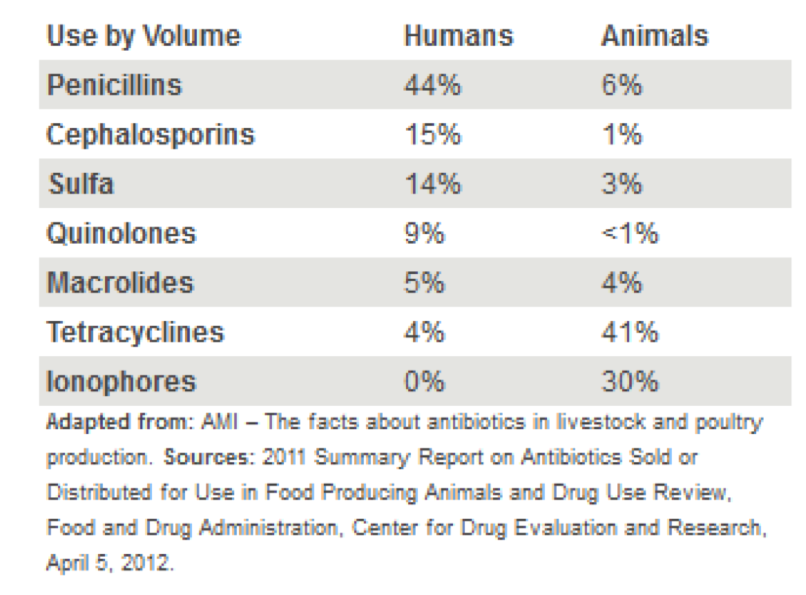
The chart below lists the antibiotics that are used for humans and the antibiotics that are used in animals. The nautical chart is showing that we rarely cantankerous the uses of the aforementioned antibiotics for humans and animals.
Source: https://jones.ces.ncsu.edu/2019/01/hormones-and-antibiotics-in-animal-production/
0 Response to "The Use of Antibiotics and the Injection of Steroids in Beef"
Post a Comment